
We are implementing a digital worker in our contact center named GAbby (yes, clever).
Implementing a digital worker isn’t just a tech deployment, it’s a people, process, and product orchestration. I’m going to build out loud here and share real life reflections from our current implementation (given that General Assembly trains on AI, it only makes sense that we too have it embedded in our own workflows.)
When we implemented “GAbby,” our AI digital worker in our Admissions Contact Center, the pilot was laser-focused on measurable outcomes: throughput, transfer rates, incremental enrollments, and cost savings. We didn’t treat it as a tech experiment—we treated it as a business experiment.
At the surface, implementing an AI-powered agent like GAbby might seem straightforward: feed it some data, map out a call script, and launch. But the reality is far more nuanced. This initiative highlighted several truths about successful digital worker implementation:
1️⃣ Training is as much about guardrails as it is about knowledge.
It’s not enough to train the digital worker on what to say. You must also rigorously define what not to say. GAbby’s early responses hallucinated offerings (like free project management courses) simply because adjacent words appeared together in queries. When AI can access broad public data, constraining its knowledge base to reliable, vetted sources is critical for brand trust and compliance.
2️⃣ Words matter more than ever.
Changing “SMS” to “text message” seems trivial, but this small fix made the agent feel more relatable. The language used by AI must reflect your customer’s voice, not robotic syntax. The user experience is judged on tone as much as accuracy.
3️⃣ Cross-functional collaboration is non-negotiable.
This wasn’t just a “tech project.” Ops leaders framed user scenarios. UX experts evaluated conversation flow. Engineers handled system constraints and testing. Vendors (thx OutRival) contributed platform and expertise. Success only came when these perspectives aligned, especially around what “done” truly looked like.
4️⃣ Personalization requires planning.
Personalizing conversations based on previous interactions or user data makes agents feel smarter, but only if the underlying CRM hooks, lead mapping, and data flows are in place. GAbby’s ability to personalize is promising, but it must be stress-tested across real-world variations and we know iteration is coming.
5️⃣ Launching isn’t the end, it’s the beginning.
Everyone involved treated this launch not as a final product but as a live experiment. There was an openness to iterate based on real interactions. That mindset (launch, listen, learn, and improve) is essential to evolving a digital worker from functional to exceptional.
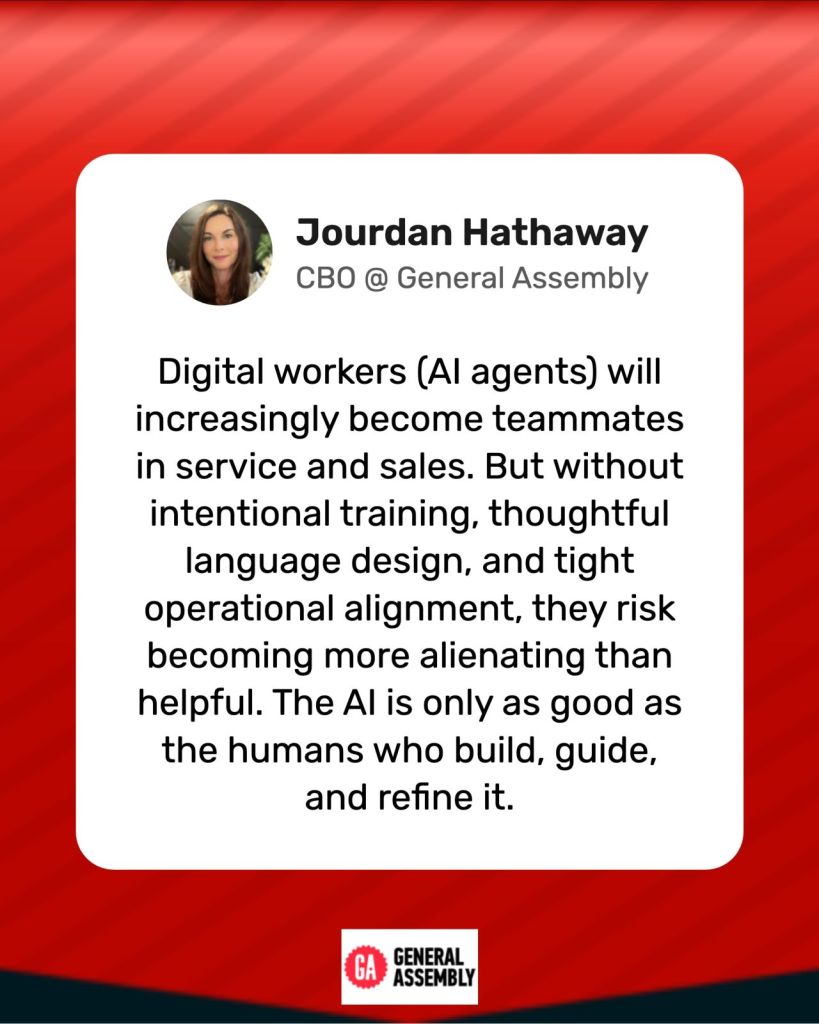
Digital workers (like GAbby) will increasingly become teammates in service and sales. But without intentional training, thoughtful language design, and tight operational alignment, they risk becoming more alienating than helpful. As this project showed, the AI is only as good as the humans who build, guide, and refine it.
 Jourdan Marie Hathaway
One thought on “Implementing a digital worker isn’t just a tech deployment, it’s a people, process, and product orchestration.”