WCET Webcast: Strategic Portfolio Development Maximizing Course Offerings While Lowering Costs

WCET Webcast Recap from Thursday, April 20, 2017

Strategic Portfolio Development (SPD) is a forward-thinking program planning approach that helps institutions position themselves to more efficiently operate in today’s market while preparing for tomorrow’s. It identifies the most strategic and scalable market-centric digital program anchors, concentrations and certificates to create a series of “suites” that build off of each other, interconnecting current and future content and program areas.

Benefits of the Strategic Portfolio Development Approach

The modular nature of this approach provides schools the ability to attract a larger section of the market to their digital offerings, maximize their use of resources, quickly increase their number of market interesting programs offered and ultimately grow a more robust and long-lasting digital presence.

Screen Shot 2017-06-27 at 9.48.56 AM

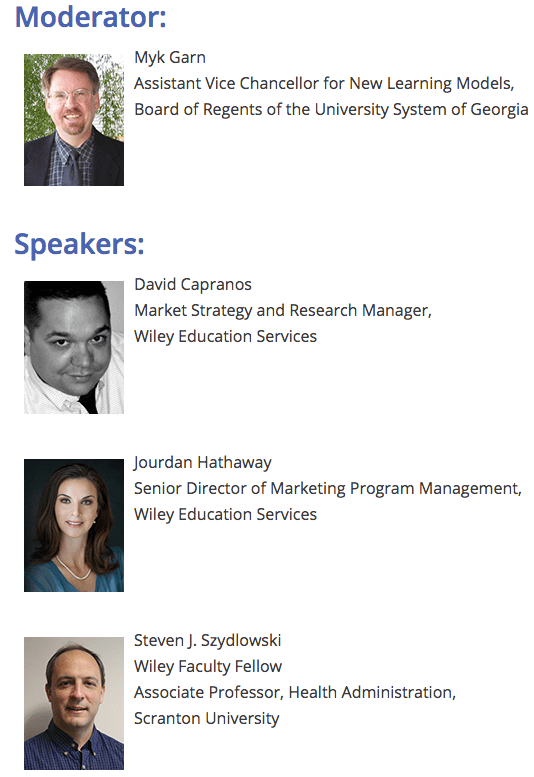
Panel Speakers

How SPD Works:

SPD involves analyzing trends in the market and understanding where the educational gaps and opportunities exist, not just to identify students, but also to help students prepare for jobs. By doing this, institutions can build efficient, flexible, and relevant online curriculums.

Connect with Wiley Education Services to learn more.

SPD helps institutions:

  • Maximize the courses they offer.
  • Quickly address changes in the market, without having to redesign an entire program.
  • Bridge outcomes with workforce expectations.
  • Identify employment needs/gaps to offer programs that will provide students with strong employment opportunities after graduation.
  • Make program planning and development more efficient.
  • Increase enrollments as students often prefer programs that allow them to focus on a specific, market relevant, specialization.

Strategic Portfolio Development – A Marketer’s Point of View

The approach of Strategic Portfolio Development influences marketing in two main ways:

  1. First, is the University’s value story in the market place
  2. Second, is the economic benefit to the marketing budget

Let’s start with unpacking how a University builds its value story. We have things like history, mission and credentials – these are long established macro-level brand ingredients. The value story is further made by factors that are rapidly evolving – program differentiation, outcomes, and the online environment itself.

The Intersection of Institutional Competency and Today’s Student Journey.

So where does Strategic Portfolio Development come in to this? In effect, it helps the school become a center of excellence in a set of scalable disciplines, which in turn, helps build competitive differentiation. While SPD has great internal benefits for the school, it’s also a student-centric approach. I like to say that it’s the intersection of institutional competency and today’s student journey. When an institution can market a depth of experience that gives students meaningful choices, the value story further grows in the marketplace.

At Wiley, our strategic marketing direction starts with a solid understanding of the product portfolio and the markets it can serve. We’re immersing ourselves in the university brand and looking to understand the in-depth details of the programs. A competitive analysis is paired with this information to provide perspective on the landscape. It gives us a feel for where to position the program, department, or university at large, that allows for market differentiation. As much as I’ve used the word market differentiation, it’s most meaningful if that is arrived at from the student’s perspective. Gone are the days of using course catalog descriptions to sufficiently describe the program. Gone are the days of the online modality being unique. Students want to know the outcomes and the ROI. If there’s a set of related choices that can better speak to the nuanced need of a chosen career path, it helps build confidence.

Impacts the Efficiency and Scale of Budget

Let’s move on to the way Strategic Portfolio Development impacts the efficiency and scale of budget.

At The Onset of Research, Not Every Student Knows Exactly Which Degree to Pursue

Sometimes there’s an assumption that every graduate student knows exactly which program they want to pursue. The reality is, many of the initial searches higher up in the funnel are very broad. Students start looking for program comparisons. This often leads to uncovering a specialization, or even a different program, that the student didn’t know existed. I’ll give you an example. I was recently looking at search index that compared the terms ‘accounting masters’, ‘accounting MBA’ and ‘business masters’. On average, there’s 76% more searches for the broad term ‘business masters’ than searches for an ‘accounting masters’. And, ‘accounting master’s has 147% more searches than typing in ‘accounting MBA’. {for all you data scientists, I know you can slice the data in infinite ways and there’s conversion impacts at every level – this stat is to help get a broad point across}.

Now let’s imagine that the school could compete with any of these phrases. That’s exactly what happens with SPD if there’s a program suite that can be co-marketed today. Even if it’s messy internally because the programs come out of different colleges, there is real strength in marketing relevant choices together. Instead of building many one-off marketing assets that support a single program, you can consolidate. The speed to market is quicker because you can add a tangential option to an existing set of assets and marketing campaigns rather than start from scratch. From a paid media perspective, digital marketing efforts can be initially targeted to a larger audience which can result in a lower cost-per-inquiry.

See a Real Example of SPD in Action

Check out the WCET Webinar to see how this plays out in Scranton’s real world portfolio example. In the marketing section, we talk about how to market at the individual program level while bringing down costs in aggregate by marketing the suite at large. Market demand then dictates how inquiries shake out by program.

At Wiley, we underpin this strategy with sophisticated media technology that allows performance targeting and conversion modeling – but that’s a webinar for a different day.

Proudly Announcing That I’m a Recipient of Wiley’s Global Pacesetter Award

What’s a Pacesetter?

Wiley’s Pacesetter Awards program honors colleagues who have made significant contributions to Wiley’s success. They are issued semi-annually on a fiscal year basis at the individual and team level. I’m so excited to share that I’m one of two recipients at the individual level.

 Winners are chosen for achieving one or more of the following criteria:

  • Significant impact on Wiley’s financial results and/or strategic goals
  • Identification of opportunities that result in acquisitions, partnerships, joint ventures or alliances
  • Significant cost savings/expense reduction
  • Resolution of critical problems and obstacles to achieving goals; responsiveness to unforeseen circumstances
  • Outstanding technological innovation that increases revenue and/or reduces cost
  • Outstanding creative effort
  • Extraordinary level of intra-company service through demonstration of professional capability, strong interpersonal relations, cooperation and helpfulness
  • Extraordinary level of external customer service and leveraging of sales through customer relationships
  • Significant improvements in products, processes and workflow, or quality orientation (should result in increased revenue or reduced costs)
  • Other achievements or results involving specific objectives, projects, activities or tasks which significantly advance progress towards department, business or company goals

So what are my thoughts on all this?

Reflections From an Overachiever

High performers need their tenacious drive and skill to be cultivated, nurtured and course-corrected to reach their maximum potential. Coming to Wiley Education Services has provided that in so many ways. I am surrounded by incredibly talented folks from whom I am learning so much from. It’s been a foundation for growth and a catalyst for mentorship upstream, down and peer-to-peer.

Since day 1, I have felt empowered and championed for across the entire organization – which has in turn cemented my commitment to our collective success. The standard for performance is high, but what I find so compelling is the intangible dedication to professional development. It goes beyond formal reviews; it unfolds every single day organically by the culture (for those who seek it). This seems like a good stopping point to plug this quote:

“We need to stop telling [women], “Get a mentor and you will excel.” Instead, we need to tell them, “Excel and you will get a mentor.”
― Sheryl Sandberg, Lean In: Women, Work, and the Will to Lead

I am also acutely aware that there is no story to tell without the efforts of my entire team. Whether they’ve helped me develop our strategic direction, or activated upon it with passion and commitment, the results are indicative of our collective strength.

Are you in a leadership role?

If yes, then I encourage you to truly invest in the talent around you. I am the byproduct of so many people investing in my academics, career and character over the years – and there’s been a lot of course correction needed along the way.  Those hallway conversations, random phone calls, late night skype sessions, impromptu brainstorms, 1:1 meetings and informal mentoring make a really big impact on folks.

Are you the spouse or partner of a woman in leadership?

I know it feels like I’m doling out some sort of Oscar speech. Believe me, I’m not taking myself too seriously here. It’s just that the recognition has given me some time to reflect on my path. This is where I have to give thanks to my #1 supporter – my husband Cam.

“When it comes time to settle down, find someone who wants an equal partner. Someone who thinks women should be smart, opinionated and ambitious. Someone who values fairness and expects or, even better, wants to do his share in the home. These men exist and, trust me, over time, nothing is sexier.”
― Sheryl Sandberg, Lean In: Women, Work, and the Will to Lead

Building the Building™ – A Construction Simulation Demonstration Program

Online learning has secured its place as a leading knowledge-transfer vehicle. During my tenure owning business operations and client success at Intellavia, I led quite a few e-learning projects. They ranged from financial association credentialing courses to hospitality courses for travel agents to adequately sell and role play to construction fundamentals.

This post refers to an interesting project aimed at young students. I was heavily involved in every aspect of the coursework and then developed the PR surrounding its launch. Here’s an excerpt…..

Commercial construction veterans Timothy H. Bernardi and Jose D. Amaya selected the orlando-based multimedia experts at Intellavia to create a unique construction simulation e-learning platform.

BUILDING THE BUILDING is a web-based, interactive education program teaching the fundamentals of commercial construction project management to a middle school thru high school audience. Using a rich multimedia environment and a challenging Construction Simulation Experience, students are introduced to commercial construction – learning the language of the trade and gaining an understanding about the day to day challenges that come with the management of a commercial construction project.

To bring the concept to life, the BUILDING THE BUILDING (BTB) team turned to Intellavia, a company with a proven track record in developing software programs that combine target-appropriate graphic design with high functioning usability. Though important with all digital communication initiatives, e-learning programs (in particular) require a well thought out user experience. BTB owners Timothy H. Bernardi and Jose D. Amaya conveyed their real-world wealth of process driven knowledge to Intellavia to create a multi-media knowledge transfer that would resonate with youngsters, teachers and the construction industry as a whole.

“Our goal was to create a young person’s guide to commercial construction project management, ” commented Timothy H. Bernardi, a BTB partner. “The cornerstone of the Building the Building program is its academic credibility.”

Jose D. Amaya continued, “The program’s content has drawn from our professional experience in commercial construction. We’ve just completed the demo and are now engaging Intellavia to build out additional portions of the program.”

The simulation demo is complete and the phase 2 academic portion is in progress. Once the full program is deployed, students will receive a comprehensive evaluation of their performance.


Building the Building – An Introduction to Commercial Construction Project Management ™ Copyright 2011. All Rights Reserved. Any reproduction of this demo by any means without the consent of Timothy H. Bernardi is prohibited. Contact timothybernardi@buildingthebuilding.com. Please Note: This edition of Building the Building – An Introduction to Commercial Construction Project Management™ has been published for demonstration purposes only.

Developing a web-based submission for The American Nurses Credentialing Center (ANCC) Magnet Recognition Program®

Executive Summary

The American Nurses Credentialing Center (ANCC) officially granted Florida Hospital for Children Magnet Recognition status, as part of its Magnet Recognition Program®, which honors hospitals for excellence in nursing. The Magnet designation makes the Walt Disney Pavilion the only hospital in Central Florida to receive this prestigious recognition. Moreover, only seven percent of the nation’s hospitals have earned this distinction. The Magnet Recognition Program honors the outstanding contributions of patient care clinicians as demonstrated through excellence achieved in leadership, clinical practice, innovations and positive outcomes. In addition to the Magnet recognition, Florida Hospital for Children was also cited for exemplary status in six areas, including community and educational partnerships, and analysis and tracking of nurse satisfaction.

The Challenge

In previous years, the 700+ pages of the documented submission were compiled and delivered in hard copy format. For efficiency, the hospital wanted to streamline the delivery process without sacrificing quality or the incredible amount of hard work that goes into preparing the tangible documents and meticulous compilation of corresponding resources.

The Solution

Intellavia was contracted as the technology partner that developed the electronic version of the Magnet submission to the ACNN. Intellavia quickly understood the magnitude of the project and worked closely with the Magnet Leadership Team to ensure all technical requirements were met. This included developing a highly-organized content delivery system with an index that followed all guidelines – along with a one-click PDF export for printing. There were over 700 pages of text and nearly 500 corresponding resources and digital assets.

Results

Intellavia leveraged the proven techniques and philosophy of User-Centered Design (UCD) to create effective web-based business solution. At the heart of this, and every project, was ensuring usability goals were met – a critical undertaking with the organization of 700+ pages of content. Ultimately, Intellavia created a highly searchable, user-intuitive, secure and protected website to deliver materials validating the outstanding contributions of patient care clinicians at Florida Hospital for Children.

Multimedia Links