💭 For junior workers, maybe it was something like leading their first cross-functional meeting, deploying their first campaign, doing their first code push, or even just participating in a brainstorm.
📊 For mid-level, maybe it was their first performance analysis presentation, a new GTM plan, leading their first sales call, or the first time they oversaw a business optimization rollout.
📗 For senior management, maybe is was the delivery of their first investment case, or a business performance update with suggested action plan, or delivering a talent assessment for #reskilling, or leading their first session in an offsite retreat.
📝 As you rise in your career, eventually all of these things become routine. On your list of to-do’s they’re completely unremarkable to you. It becomes second nature, maybe even monotonous sometimes.
😫 But, can you go back to your younger self, and remember what those nerves were like when you had to do these things for the very first time? You wanted so badly to do a great job. Maybe you were anxious and unsure of yourself. Perhaps you had imposture syndrome galore (I sure did).
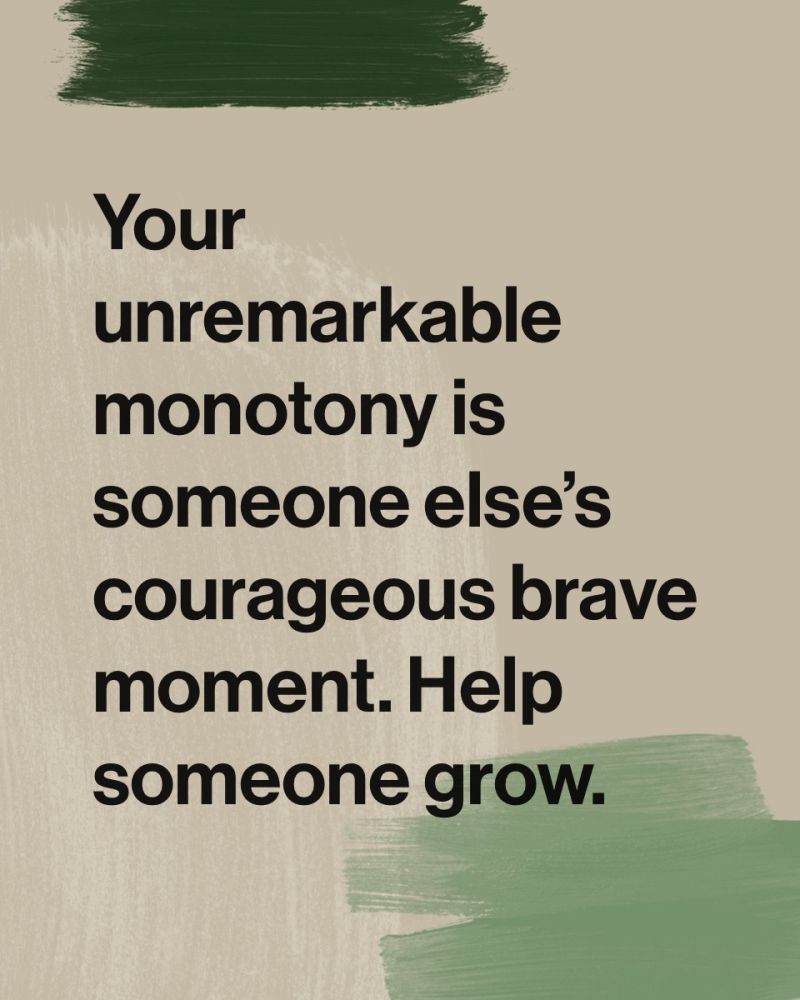
Your unremarkable monotony is someone else’s courageous brave moment. Help someone grow.
🧗♂️ So, if you noticed your co-worker doing something for the first time – their courageous brave moment – show ‘em some support. Before you deliver pointers for how to improve (which you should do), first let them know you’re proud of them for achieving that milestone. Let them know that you are here to help them workshop their delivery and provide your own experiences (good bad otherwise) for how you got better. Help them put in their reps, trouble shoot, and up their game. Call it out when they’ve nailed it. Celebrate with them. Help someone grow. It will fill your bucket.
YOU have to own your own professional development
☝ I also strongly believe YOU have to own your own professional development. If you are the one who is doing some of these things for the first time #upskilling , take a course/workshop/class/something and also reach out and genuinely ask for support. Chances are there’s someone in your corner who is a champion. Leverage it. It’s a two-way street so when you use their advice, let them know that you got value from it. Make observations about their routine delivery that you aspire to and let the person know it’s what you’re working towards. This is how you build strategic relationships.
If you’ve made it this far – Like. Comment. Or Repost.
There are chapters in your career journey that feel like you’re at warp speed, careening around the bend hoping that you’re on the right track. The adrenaline and nerves of learning how to do new things, tackle business challenges, and solve customer needs require a lot of trips around the track and taking adequate pit stops (making the right adjustments or even changing drivers if you need to #upskilling#reskilling ). You might have an occasional spin out and drift – it’s ok. I’ve had that both figuratively and literally. This top photo is the time I let some industry friends talk me into a drifting ride-along during a once-in-a-lifetime experience at a conference years ago. I met people there that I still connect with today – building your network is so important.
Confidently Cruising
There are also chapters in your career where you’ll feel like you are confidently cruising. That you’ve hit your stride – you’ve done enough trips around a particular track that you know just what to do. You don’t come off as trying to sell anything because you now talk about the obvious path forward with contagious ease. Enjoy those seasons; a change in macro-economic conditions or customer preference is coming for ya 🙂 Your cruise will be short-lived; and if it’s not, you’re probably bored.
Your Mindset and Who You’reHanging With
It’s been 25 years since my first internship from where I’m at today. Some of my biggest learns are that it’s your mindset, and who you’re caravanning with along the way, that will make the biggest difference in your career journey.
Are you anxiously careening around the bend at warp speed right now wondering if you’re on the right track? Find someone who has been there, done that, and let them help guide/support you.
Have you confidently hit your stride and are cruising? Maybe you are just the someone to help guide/support 🙂
After recently announcing my new 🔥 role as General Assembly‘s new Chief Marketing Officer (which I’m absolutely 💕 loving BTW), I started receiving hundreds of LinkedIn messages like this: “Hi, I saw yesterday you joined GA as the new CMO. Congrats. Can I schedule a demo of our product next week so our team can tell you what we do for marketers?” One person asked what my💰budget was (yikes 😱). Definitely an important❓question during the sales cycle, but not an opening one of a ❄ cold outreach the day someone gets hired. On the other hand, there were so many thoughtful outreaches filled with great info, industry insights, support, and a genuine desire to build relationships. What a treasure trove of opportunity!
The First 90 Days Vs. The Long Game
I wanted to share some insight into what the first 9️⃣ 0️⃣ days typically 👀 looks like for a new CMO. LinkedIn is an incredible place so I’ll share some thoughts to help you harness it.
I’ll be back to reveal some of the 📨 outreaches I found very valuable 😁 that did or will lead to 📞 meetings, 🤝 connections, and yes…even… ✔ sales (at some point, just not day 1). PS – So many of you of you are 🏋crushing it out there! I’m so appreciative of the connections, learning, networking, and support that LinkedIn creates.
Before I do that, here’s what on my mind:
The first few days, weeks, and even months 📆 are not typically when a new CMO is ready to take a cold call for a demo of a product that may or may not solve a problem that may or may not be there that may or may not be prioritized this year. Instead, they are:
Working their way through the list of activities below (keep reading, it’s at the end)
Getting acclimated to the business
Understanding their CEO’s vision
Learning about the needs of their customers
Building great internal relationships (the key to success for any org)
Forging meaningful connections with existing partners
Natural Synergies, Existing Relationships, and Critical Priorities Take Precedence
For all your Sales Farmers out there, there’s some good news because a newbie is probably going to look to an existing relationship to see if they can solve a particular gap in the early days (don’t come in too hot on day 1). They are also going to look for natural synergies across the existing landscape to find quick wins. They are likely walking into their team having a laundry list of in-flight critical projects and will want to get dialed in to the expertise of their teams and getting those efforts across the goal line.
Documenting Capability Gaps and Solidifying Solution Requirements Before a Demo is Best
Long before anyone is ready for a product demo, a few things need to be true: business and marketing goals need to be created, a strategic plan crystalized, a set of real problems/blockers identified, collective agreement on prioritization established, and for the spots where a new product/service is needed – a set of business and functional requirements created cross-departmentally should be solidified.
First 90 Days Activities: Consider How To Tailor Your Outreach With This in Mind
If you are about to reach out to a new CMO in LinkedIn, here’s what they are likely focused on – consider how you can tailor your outreach knowing this is what’s on their plate:
Meeting Stakeholders & Building Relationships at Every Level
Learning the Operating Models
Understanding The 1-3 year Business Vision, and FY Priorities
Diving into Financials & Revenue Drivers
Digesting Documentation Galore
Scoping Out the Competitive Landscape
Obsessing Over Customer Insights
Learning The Other Departments (winning as a business means there’s strong connectivity, trust, and reciprocal value generation between departments)
Marketing Performance Audit
Budget Reviews and Reporting Familiarization
Technology Stack Review and Training
Goal Setting & Strategic Planning
Team Alignment, Empowerment & Having Some Fun (ask me about our recent pet photo contest)
Campaign Launches Review
Performance Metrics Digestion
Establishing Feedback Loops and Figuring Out How To Best Navigate The Org –(i.e, who to go to for things and how to quickly build reciprocal, productive relationships at every level)
Vendor Assessments Including End User Assessments (is the thing doing the thing intended?)
Keep At It – Eventually Luck & Intentionality Lead to Something
LinkedIn, mentorships, networking, conferences, or any conduits of building relationships may yield the connections needed for two people to swap their expertise down the road. You’ll never know when the timing lines up, but I find it’s typically a worthwhile pursuit with the right approach.
What the heck is “Project FLAT”? It’s the very specific self-authored professional development plan I put myself on during a pivotal growth moment in my career– It stands for Financial Literacy Advancement Training (to get excited, I had to market it to myself). Since I care deeply about mentoring others and talent development in general, I thought I’d share my personal journey and freely hand out the actual plan I created and followed.
In case I need a little street cred – I was the SVP of Operations for a global EdTech & Professional Services business (a division COO within a publicly traded company). I’ve led through a 4.5X scale (organic and inorganic growth). Back in 2020, I advanced to that senior executive role where I oversaw the functional areas across the full Student Lifecycle: marketing, enrollment, retention/student advising, product, academic services, operations, and change management (7 functions, 800+ colleagues, 55 job functions). Prior to that role, I was VP of Marketing leading a department of 150 people across 18 marketing disciplines. Today, I’m a Chief Business Officer (transitioned from Chief Marketing Officer. I oscillate from a CBO, COO, or CMO – all just depends on the particular opportunity and my skillset fit relative to what the organization needs at particular point in time. Even when I was in pure marketing, I was always a “moperator” – a marketer obsessed with the operations behind it.
In all 3 of those roles, I have been lucky enough to be surrounded by highly effective, really great talent (one of the keys to any successful business).
So how did I make the transition from head of marketing to an executive operations role at the senior level and then on to the C-suite? With all of this in the rear-view, I can reflect and look back at the steps:
Identify your gaps
Own your professional development
Do. The. Work.
Network like crazy along your learning journey
Apply your learns along the way and let others know what you’re working on
Pay it forward with your new (or old) domain of expertise
Don’t stress about the sunk cost fallacy if you want to change course down the road
I am going to break down each of the steps and share exactly what I did
I’m also freely handing out the actual plan I created and followed. One of the things I love is when others who have ‘been there done that’ share some of the real-life resources and artifacts that led to their success (whatever the domain is). It demystifies things. Earlier in my career, I wondered how executive leaders got to where they were. Did they still do development plans? Did they still have skills gaps at that level? If so, what did they do about it? How the heck did they all seem to speak finance?
There’s a bajillion paths to get here, this is mine.
Back in 2020, I self-identified the need to “flatten my own learning curve” so to speak – particularly focused on financial literacy and acumen. It’s also a metaphor for “leveling the playing field”, giving me the same chance of succeeding in rooms/situations where there’s an established common language and laser focus on financial matters. Get it? FLAT. (let her have it, she thinks she’s clever with the pithy acronym.)
Rather than change management, team leadership, customer-centricity, organizational savvy, problem-solving, or the marketing and technology disciplines, I chose to focus development on advancing my financial literacy, with the supposition that the other areas already had a proven track record of high competency.
What’s your operating profit margin and what’s increasing your COGS? Huh? Say what?
When highly successful (non-finance) employees are promoted to positions of executive leadership, it is sometimes assumed that they suddenly understand the new rung of financial information being provided to them. That’s typically not true (The Dismal Financial IQ of US Managers,HBR.org). You don’t suddenly wake up one morning and speak EBITDA. But, it’s the language of business and if you want a reach a certain level, it’s a domain you may need to upskill.
Self-Assessment
I did a self-assessment of my financial literacy and acumen and figured I was squarely at stage 2.
Stage 1: Unconsciously Incompetent “I don’t know what I don’t know.”
Stage 2: Consciously Incompetent “I know what I don’t know.”
Stage 3: Consciously Competent “I grow and know and it starts to show.”
Stage 4: Unconsciously Competent or Mastery “I simply go because of what I know.”
Factor 1: Thought | Cluster A: Understanding the Business | Competency 17: Financial Acumen Korn Ferry Leadership Architect™ Global Competency Framework (Book: FYI For Your Improvement)
I put together this document which contained my Professional Development Plan. I wanted to create a roadmap containing the skills, actions, and conscious intentionality needed to further myself in my career (and life) to achieve my professional goals. My aim with this plan was to consciously work on developing myself so I could advance my higher-level competencies; and subsequently, the application of them to further our organization’s goals (professional development ideally advances yourself AND the business you are working for).
I also got really clear on the benefits that I was seeking with all of this:
Non-finance leaders, regardless of their primary domain of expertise, can significantly benefit from gaining a fundamental understanding of finance for quite a few reasons:
Decision Making: Financial acumen will allow me to make informed decisions that consider both the strategic and financial implications of my choices. I’ll be able to evaluate projects and initiatives not only in terms of their qualitative value but also in terms of ROI, payback period, and NPV (had to learn what the heck that means), among other financial metrics.
Resource Allocation: As a leader, I often must decide how to best allocate resources within my teams or departments. Understanding financial concepts can help me have another lens to prioritize projects or initiatives that offer the best financial returns.
Budgeting and Forecasting: Non-finance leaders are typically responsible for their department’s budget. Understanding how to create, manage, and forecast budgets is essential to ensuring my department remains financially viable and aligned with our broader business goals.
Communication with Finance Teams: Having a basic understanding of financial principles will enable better communication with the finance department. It will allow me to understand and justify budget requests, interpret financial reports, and actively participate in financial discussions in a more substantive way.
Strategic Planning: Financial literacy is integral to strategic planning. With a deeper financial understanding, I could better align the department’s strategies to our financial goals, ensuring congruence and maximizing my department’s contribution.
Risk Management: Financial knowledge helps in assessing the financial risks associated with various decisions. This will help with my decision-making in taking informed risks or creating strategies to mitigate potential downsides.
Enhanced Credibility: When I upskill in this area and demonstrate a grasp of financial concepts, I’ll inherently broaden my credibility. I’ll become a more well-rounded professional who understands the broader business context.
Career Advancement: As professionals climb the corporate ladder, a broader skill set that includes financial acumen becomes increasingly important. To continue elevating, I’ll need to understand the financial health of the entire organization, even if my primary expertise lies elsewhere.
Stakeholder Engagement: From QBRs to earnings prep, I engage with many different stakeholders. While I know the marketing numbers fluently, being conversant in finance will help in communicating the value props, project ROIs, and financial stability of projects.
Holistic Business Understanding: I’m keenly aware that finance is the language of business. To understand our business holistically, I need to appreciate how different functions interact and contribute to the bottom line. Financial knowledge provides a lens to evaluate these interactions.
Upskilling Myself with Project FLAT (Financial Literacy Advancement Training) will aid in making more effective decisions and will foster a comprehensive understanding of the business, enabling me to contribute more significantly to our overall success.
My goal was not to become a finance expert, but rather to understand finance and how to incorporate a financial thinking lens into every major decision made. Practically speaking, I made a self-paced, time-bound, set of development activities and then literally put each of these things on my calendar. Every description said: “Project FLAT daily non-negotiable calendar block”. Did I always do them exactly when planned? Nope, but I never went to bed before I did the work (ok, not never, but nearly never). 70% of the time, I adhered to my prescheduled time blocks for this. Sometimes this meant I brought my laptop to my daughter’s volleyball tournament and completed coursework on breaks. Sometimes I had to get up really early and bang out some reading. Sometimes I had to switch out Pearl Jam on my earbuds while working out in favor of finance podcasts (not sure those workouts were very hype lol). It goes without saying I am not suggesting you run yourself into the ground nor should you miss your kid’s middle block in a weekend tournament because you prioritized your job – no way – I just mean that you’ll make ⏲ time for what you prioritize. Find whatever works for you. Key takeaway: you’ll make time for what you prioritize.
What work?
Articles, books, decks, earnings calls, P&L reviews, more P&L reviews, then some more P&L reviews, online courses, mentor sessions, formal and casual “can you help me” meetings, more P&L reviews (at one point unfamiliar, but now status quo), certificate credentialing programs, memos, random questions to clarify a term or concept (a bajillion of those) – do the things. No way of getting around it. Do. The. Work.
Looking back, if I had to pick the most useful/impactful learning mechanism, what would it be?
Which learning asset gave me the most bang for my buck?
Did I learn the most from all the articles and books I read? Was it the certificate program I completed? Was it learning how to assemble and analyze QBRs and all the supporting business performance documents in a cross-functional workgroup? Was it listening to earnings calls and reading valuation memorandums? How about reading P&Ls until my eyes watered? (sorry I realize this sounds cringy and obnoxious, I’m just reinforcing the work it took to upskill.)
One person’s knowledge isn’t enough for collective success.
It wasn’t one of them. It was the power of all of them combined. I also really believe the secret sauce was NETWORKING LIKE CRAZY throughout. All of the academic learning came alive when I could chat with a diverse group of finance and business management contacts – or fellow novices also upskilling. Businesses are a collection of people who align around a mission and goals. One person’s knowledge isn’t enough for collective success.
The point is, there is so much to learn from the people around you. Don’t miss an opportunity to be vulnerable and seek guidance from all the SMEs in your life.
How apropos, in all my love of networking, I was seated next to Alex D. Tremble, the author of ‘Relationships That Work: 4 Simple Steps to Building Intentional Connections in Business and in Life‘ at a conference. I’ll quote something from Chapter 09 of his book. “Becoming a great networker allows you to solve problems and attain the relationships that can assist you in growing personally as well as professionally.” Yep, nailed it.
I think so much of this networking aspect that I need to double down on it. I don’t want to just vaguely throw out the importance of networking. I’m going to give you tons of real-life examples of how I did this
5. Apply Your Learns Along the Way and Let Others Know What You’re Working On
This step is the crème de la crème of the secret sauce. There’s no shame in sharing that the sauce is made up of many different recipes given by others who were willing to share – then you put your own signature on it. Ya gotta give credit and gratitude along the way. How cryptic – sorry – back to Finance Literacy Advancement Training (FLAT). In Step 4, I mentioned there is so much to learn from the people around you. Don’t miss an opportunity to be vulnerable and seek guidance from all the SMEs in your life. I promised to show what that looked like for me with real-world examples so here goes:
Buddy System: When I enrolled in the certificate program, I did it with a co-worker. At first, we’d lament over the unfamiliar finance terms; towards the end, we debated P&L drivers and case study observations. She made the whole thing more enjoyable and productive.
Network Groups: When the program offered a Facebook group – I joined, connected, and engaged (fast forward a few years and I’ve helped 2 people from that cohort with their new job – it’s how the world often works.)
Meeting Follow-Ups: When I attended an earnings call, I took notes and drafted questions. Then I scheduled a meeting with our head of investor relations (whom I didn’t know well beforehand but became a wealth of learning for me and a treasured connection). I let him know I was in learning mode, and he was generous with his time to answer my questions.
Manager 1:1: In every 1:1 with the President of our business (aka, my manager), we’d chat through recent learns. I’d ask all sorts of questions about what’s important to him (a CEO) in his decision-making (constructs that I previously wouldn’t have spent much time thinking about since I was mostly obsessed with ROAS at the time – and I still am BTW). He was very supportive. I’d like to think I’ve made it easy for people to root for me because they know I’m trying to continually better myself and that I’m all in on helping others do the same.
Ask Questions and Prepare to Listen: When I had a forecast, budget, or investment case to do – I scheduled time with our finance and performance teams (from the CFO and SVP/VPs to the Directors and Managers – every layer of the finance team – yes, all of them). I’d ask how they’d analyze the ROI of a particular decision or project I was working on. I asked them to poke holes in my assumptions. I’d ask how I could better set up the taxonomy to help with easier backend reporting. I took notes, I listened, I applied. BTW, some of those mid-level managers are now senior executives who became my primary stakeholders. It’s a lesson in ALWAYS treating people well. I’ll never forget their patience with me and I’d like to think they’ll always remember my vulnerability as a senior leader.
Making the Most of Workgroups: When I had to help assemble and analyze QBRs, and all the supporting business performance documents in a super-talented cross-functional workgroup, I’d ask each person’s POV. I had to learn how they interpret their domains and relate them back to financial matters. I’d ask questions. We’d debate assumptions. I’d be wrong a lot about how certain drivers relate. Conversely, sometimes I could spot things that were overlooked. I was engaged, curious, and respectful. Each month I leveled up. We all did. That’s how it goes.
After every QBR – I’d write my self-reflections of things I would have said differently. Then I’d figure out which of the senior executives on that call was an expert in the thing I botched. I’d immediately reach out and workshop how to approach it better next time. From our Chief Marketing Officer and Head of Legal to our Chief Strategy Officer and all our Business Performance Executives – I put myself out there. You’ll find that nearly everyone is willing to support your growth if you come with the right attitude and display authentic vulnerability (you better have their backs when they need your support as well).
If you can’t read my chicken scratch from the above very real notebook I keep for continuous improvement, here’s what I observed in one particular QBR:
Communication Improvement Area: Get tighter on key points and do not confuse the room with multiple variables. Have 1:1 points and don’t have multiple aspects of a point! Use more simple language vs jargon and get to the dang point quickly
Better from Prior: Not feeling compelled to answer when I’m not ready. I did better at not answering when I didn’t have enough info to do so re: a question on market response and looming economics which needed more time to formulate a set of hypotheses
Then, when I did it better, I’d take the time to send a thank you note about how that person’s guidance helped me level up. People appreciate and remember things like that. (Your mom was right; send thank yous)
Leverage Your Internal and External Networks
It wasn’t just internal colleagues; I live a few doors down from a retired CFO of a huge organization – I used to try and time my dog walks when he was out just to ask a few finance questions. I was honest about my gaps and upskilling quest, and he would give me nuggets of wisdom.
I’ve also remained in contact with dozens of former business and finance-savvy colleagues who are at new companies now. I continue to learn from diverse views on the factors impacting the EdTech space and all sorts of macroeconomic perspectives – it’s invaluable (disclaimer: I’m of course talking about things that are appropriate to discuss with an external network, not crossing the boundary of confidentiality or sensitive materials). Reaching out over and over and over again to learn from my network has been so invaluable to my professional growth and my ability to drive impact. It’s a symbiotic relationship though. If you ask for time, you should also be willing to give yours. Again, people remember things like this.
Final thoughts on this:
I think there are 3 things that happen when you genuinely engage with people, and they see you working on a skills gap in this way:
They give you more grace when you botch something (they might even help you fix it)
They see you in an elevated capacity because you’re someone who is willing to do the work and apply it
They end up connecting you to future opportunities that can advance your career (how I landed in the role I have today)
6. Pay it forward with your new (or old) domain of expertise
Remember alllllll that time others spent with me as I worked through my year-long Project FLAT? There’s a duty to pay that forward. Doing so creates an environment where everyone can grow, innovate, and thrive. It solidifies a leader’s role as both a steward of the company’s current successes and a shepherd guiding its future.
Giving Back: After benefiting from mentors and experiences during your own journey, sharing your expertise is a way to give back to the community and sectors that shaped you.
Personal Growth: Teaching and mentoring others can further refine your own understanding of the domain. By articulating complex concepts to someone else, you can often gain new insights yourself.
Building Stronger Relationships: Sharing expertise helps build deeper, more trusting relationships. It demonstrates that you’re invested in the growth and success of others, which can foster loyalty and camaraderie.
Broadening Perspectives: Engaging with individuals at different career stages can provide fresh perspectives, helping senior executives stay adaptable and innovative.
PS: just because you master all the finance jargon (or marketing jargon, tech jargon, or whatever your jargon du jour is) does not mean you’ve become an effective communicator, leader, or problem solver in that domain. You have to apply your competencies in practical terms and speak to business operations and financial matters in simple words.
I’ll plug another book Straight Talk Your Way to Success by Dan Veitkus whom I’ve had the pleasure of meeting. It “exposes the difference between spending time, energy, and intellectual firepower trying to sound smart and savvy versus the more effective choice to speak and operate deliberately in order to avoid confusion, frustration, and wasted time to improve productivity”. C’mon, I bet you totally relate to a meeting you sat through riddled with jargon and groupthink without anything productive coming out of it. Are you smiling? Was it earlier today?
7. Don’t Stress About The Sunk Cost Fallacy If You Want To Change Course Down The Road
The sunk cost fallacy is our tendency to continue with an endeavor we’ve invested money, effort, or time into—even if the current costs outweigh the benefits. It’s not a phrase I would have thrown out pre-Project FLAT.
Professional development is more than acquiring skills or climbing the career ladder. It’s a personal journey of growth, adaptability, and self-discovery. Yet, many remain anchored by the ‘sunk cost fallacy’, hesitant to pivot due to past investments. For instance, if after extensive financial literacy training, I didn’t directly use those finance concepts daily, it doesn’t negate the value. That journey honed my problem-solving skills, showcased my resilience, expanded my network, and fostered self-awareness. It taught me I can learn new things and it demonstrated that to everyone who watched me on the journey. Life is vast, unpredictable, and full of potential learning experiences. Every course, interaction, and experience, contributes to growth. Embrace the journey, celebrate your evolution, and remain open to the myriad possibilities that lie ahead.
If you’re still reading, thank you! I hope you found value in my real-life professional development plan that took me from a VP of Marketing to an SVP of Operations. For me, Project FLAT wasn’t a sunk cost, but a real catalyst. I didn’t know at the time when I embarked on that professional development plan as a marketer that I’d land at the intersection of opportunity and preparedness to become an executive operator.
Embrace the journey, celebrate your evolution, and remain open to the myriad possibilities that lie ahead.
During the research and decision-making phase of the enrollment journey, there are 84 recurring questions that are asked – here they are, organized into 10 categories
Over the years, our enrollment team has had millions of appointments and consultative interactives with prospective students (caveat: largely talking adult learners and online programs here). During the research and decision-making phase of program selection, there are common questions that routinely come up. Before students submit their applications, here’s some of the info they are gathering. For convenience, they are organized into 10 main categories. This is not every question ever asked – just the most common ones. While some of these may seem very basic, perhaps you love a tidy organized list of customer insights as I do. From there, it can fuel marketing, student engagement, internal training, and tech-enabled content delivery at scale.
What to do with this list?
Know Thy Product – make sure everyone supporting students can easily answer questions like this. When I first started, we had physical binders with this stuff. I think I even owned Whiteout when I wanted to update tuition. How barbaric! 81 questions x 800+ program offerings are ~65K Q&As to maintain. Thank goodness for content databases, cross-functional wikis, data governance teams/systems, and digital training courses. (PS – bonus points to any hoarders out there who post a picture of a binder they still have).
Utilize in Marketing – you don’t want a 7-year-old post on Reddit to be the only place a prospective student can find out if work experience is required for the degree they are interested in. Take stock of your marketing and lead nurturing assets to make sure you have the most up-to-date information. Depending on your lead-to-contact and contact-to-appointment rates, we can assume there’s a significant portion of your prospective student pipeline who you won’t end up directly engaging with so make sure there are plenty of ways for self-service info gathering.
Student Engagement and Tech-Enabled Content Delivery at Scale – by now, we’re all connecting with students through chatbots, live chats, messenger, emails, texts, and yes – definitely still the phone. For accuracy and consistency, it’s helpful when people and systems can all access the same info. This is where a marketing automation team will focus on the importance of highly functioning bi-directional syncs of content databases to email/SMS/chat tools or why diry data is a success poison. Punchline – there are a ton of ways to scale content delivery.
AI – I was scared to post this article without using the letters AI. Can I just leave a blank paragraph on this topic for now?
Enough already, just give me the tidy organized list! Got it, here it is:
Admissions
1. Do you provide credits for work experience?
2. Do you provide visa sponsorship?
3. Is there a GMAT/GRE entrance exam?
4. Is work experience required?
5. What are the admissions requirements?
6. What are the start dates throughout the year?
7. What type of transfer credits do you accept?
8. I’m a seasoned professional, do you offer a way to leverage my experience like Advanced Standing?
Application Process
9. Do I need all pieces of my application before applying?
10. Do you have an application fee waiver?
11. How do I apply for the program? (Application step-by-step walkthrough)
12. What is the application review process?
13. How long does the application process usually take?
14. How quickly will my file be reviewed?
15. Is there an application extension?
16. Is there provisional acceptance?
17. What’s the application deadline?
18. Who should I ask for letters of recommendation?
19. How many letters of recommendation are needed?
20. What is a statement of purpose?
21. What is the difference between an official and unofficial transcript?
Coursework and Faculty
22. Am I able to take any courses on campus even though I am applying as an online student?
23. Are classes synchronous or asynchronous?
24. Are there live virtual sessions with my professors?
25. Are there proctored exams?
26. Can I take just one or two of the classes without pursuing a full degree or certificate?
27. How is the online program different than the campus version?
28. How many classes are taken at a time?
29. How many total credit hours are needed?
30. Is there a particular order in which I must take classes?
31. What are the courses of the program?
32. What are the ways I am able to interact with faculty members?
33. What days are assignments normally due?
34. What technology and apps will I need?
35. Who teaches the courses?
Experience
36. Can you take breaks throughout the program?
37. How do you work with the military during deployments overseas?
38. How many students am I in class with?
39. Is the program mostly full-time faculty or adjuncts?
40. Is this a cohort?
41. May I speak with a current student?
42. What does a typical week as an online student look like?
43. What type of faculty and student interaction is there in an online program?
44. What type of networking opportunities are there?
45. What is the online learning experience like?
Tuition and Fees
46. Am I able to defer payment if being reimbursed through my employer?
47. Are there scholarships for this program?
48. Are there any other fees associated with my program other than tuition?
49. Can I receive a discount on my tuition if I pay for the entire year?
50. Is there a monthly payment plan for tuition?
51. How do I apply for a student loan?
52. If my program will be employer-sponsored, what is the payment process?
53. What are my funding options?
54. What is the cost per credit?
55. What is the difference between FAFSA and Sallie Mae loans?
56. What is the total anticipated tuition?
57. What tuition benefits are offered to active military and veterans?
Graduation
58. I’m an online student, can I walk in graduation?
59. What specifically will be on my diploma?
Program and School Info
60. Are you a yellow ribbon school?
61. Can I do a blended/hybrid program (campus & online)?
62. Do I have to pick a concentration?
63. What is the physical address of the main campus?
64. How long has the University been offering this degree or certificate online?
65. Is there a full-time option or part-time only?
66. How fast can I complete the program? (Least amount of time)
67. Is the online degree the same curriculum as the on-campus degree?
68. How long do I have to complete the program? (Longest amount of time)
69. Is there a residency component?
70. Is this program accredited?
71. Which degrees and certificates can be taken online?
72. Are clinical waivers available?
Career Outlook
73. What is the career outlook for graduates of this program?
74. Does this degree prepare me to become licensed in ….?
75. What type of job can I pursue with this degree?
76. I’m going back to school so I can advance at my current job, will this program teach me how to…?
Student Resources
77. Is there a {virtual} open house?
78. Do you provide any training on the learning management tool / LMS?
79. Do you offer job placement?
80. What resources does the school provide for students with disabilities?
81. Will I have technical support?
Time Management
82. Can working professionals with families really do this?
83. How much time will I have to devote to the program on a weekly basis?
84. Any tips on how to manage my time?
————
This list of questions is simply sharing what’s on the minds of prospective students pre-application from the millions of real-world interactions we’ve had. Education does not guarantee outcomes including but not limited to employment or future earnings potential. Admissions standards and decisions, faculty and course instruction, tuition and fee rates, financial assistance, credit transferability, academic criteria for licensure, and the curriculum are the responsibility of the Institution.
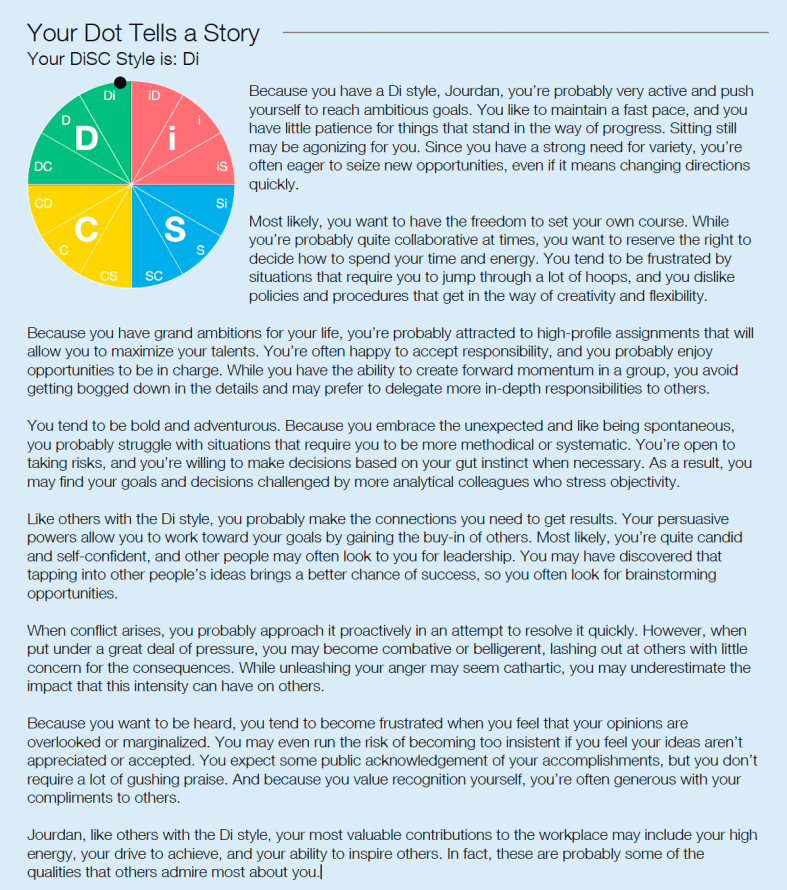
DiSC® is a personal assessment tool used by more than one million people every year to help improve teamwork, communication, and productivity in the workplace. Leaders become more naturally effective when they understand the dispositions and preferred working styles of not just themself, but also those they work with. With over 40 years of research-backed assessment expertise, it helps creates a common language and self-awareness. Here’s me – I have a Di style and it’s pretty spot on.
Higher education is very politically polarized right now and is in the news daily – from the ROI of a degree and the loan debt crisis to job readiness and equity/accessibility. Enrollments have been trending down for more than a decade and there are loads of systemic challenges being discussed. The below content doesn’t discuss any of that. Below is a summary of the content that was gathered when a few higher ed folks got together for a casual and informal discussion specifically on career-connected education and some of the obstacles universities (and B2B partners) cite when thinking about shorter, job-relevant programming for today’s workforce needs. It’s not exhaustive by any means, just some of the themes that higher ed professionals face in this topical domain. Yes, it’s totally biased to a few points – it was a focused conversation. It’s worth sharing because it’s important to bring people together who are working to solve similar problems – so here goes…..
Universities and Career-Connected Education
It’s certainly not suitable for everyone, nor is it the only path, but the traditional path of a college degree remains a vital and important option for career mobility – at least for the foreseeable future. Degrees provide a foundation of knowledge and cognitive abilities, forming a comprehensive perspective that equips learners to navigate diverse challenges in their professional journey. Degrees remain an essential component of career progression and personal development. That said, many in the higher ed industry are also deeply aware of (and focused on) the widening skills gap in our labor markets and are looking for ways to close the chasm for tighter career-connected learning. It’s a complex and multi-faceted issue, but there’s an exciting proliferation of interest and actions happening in the market today.
Competing in the Upskilling Marketplace
In the face of rising competition in the upskilling marketplace, some universities struggle to maintain their relevance (actually more than “some”, it’s “many”). The higher education sector finds itself vying against various entities – from certification bodies, industry associations, or professional associations to learning providers like Google and LinkedIn Learning. In some cases, work experience or industry credentials are seen as more valuable to an employer to demonstrate a particular set of competencies and skills. For learners looking for the total package, universities must carve out their unique value propositions, they have hundreds of years of expertise with bachelor’s, master’s, and terminal degree programs. Today, there are additional expectations to:
Further embed specialized credentials from industry-specific organizations
Accelerate frameworks (and scalable AI solutions) that allow the curriculum to be more aligned with skills-based programming (at the industry level and even down to the specific employer level) – this isn’t just about hard skills; soft skills mapping is critical too
Give adequate and fair credit for military or prior work experience such that it appropriately maps to specific job requirements
Universities and Career-Connected Education
This is a sweeping generalization from decades of working in higher-ed, obviously, not all institutions face the same challenges, but there are common themes that show up on this topic. When discussing career-connected education with universities, they generally express enthusiasm for job-relevant programming. However, obstacles tend to be operational and practical. Universities grapple with aligning curriculum to career pathways and developing alternative pathways for students for whom a traditional four-year degree is not an option. These challenges are really exacerbated for universities when it comes to alternate pathways – meaning non-degree learning products (to be clear, there are a lot of institutions and companies doing fantastic work in this space). Moreover, industries don’t always clearly define the micro-skills needed for specific jobs, making it challenging for educators to create relevant skill-based programs. There is no standardized system for recognizing acquired job skills. Degrees and diplomas still hold sway due to their standardization, whereas certs/badges for specific micro-skills are less recognized, although this is rapidly changing.
AI will no doubt solve these things, but it’s not been adopted and scaled yet in a way that institutions and employers have equally forged to mutual understanding and satisfaction (yes at some point, this will be embarrassingly outdated). Today, curriculum-to-job-skills translation mapping (and vice versa) still requires some type of oversight and taxonomizing from a human SME who can translate and bridge gaps – and figure out where to prioritize opportunities. It can be a slow-moving slog with the amount of stakeholders involved.
Economic Challenges for Universities
Universities play a pivotal role in providing upskilling opportunities. However, they are often stymied by the economics of running these programs and connecting them to learners and employers. Competitive learning products can be expensive to develop and sustain if not carefully executed. At the end of the day, they must have reasonable unit economics. Rightfully so, the market demands a low price point for short-form learning products. The business model must make sense after you consider development and maintenance expenses along with the cost of student acquisition (e.g., marketing costs). Universities on their own are often unable to cost-effectively compete in a direct-to-consumer market; this is where employer partnerships and strategic B2B relationships become so important. Of course, there are indeed institutions that do have sustainable organic learner traffic at scale, great D2C e-commerce experiences for non-degree upskilling products, and mutually productive skills-focused employer arrangements – but many more that do not, and they and their partners are grappling with ways to win in this space.
Upskilling and Degree Requirements
Upskilling and credentialing continue to be pressing topics in today’s labor market. There are many complex obstacles to solve for both employers and educational institutions. For the upskilling paradigm to succeed, hiring requirements need an overhaul. Many employers still rely heavily on traditional bachelor’s degree requirements, even when the candidate may hold significant military experience, work experience, or alternate job skills credentials. The sirens are going off though as we’re already starting to see employers and states dropping the bachelor’s degree as a job requirement. Perhaps it’s not an either-or resolution – the world is evolving where there are different paths to prove competency and job readiness.
The Need for Lifelong Learning
The rapidly evolving professional landscape necessitates continuous learning, even after obtaining a job. Lifelong learning products are indispensable in catering to these emerging needs. Such educational resources, which may include online courses, workshops, certificates, apprenticeships, or badges to name a few, allow individuals to enhance their skillsets and remain competitive in a changing job market. They offer the flexibility to accommodate personal and professional commitments while pursuing further education.
Technology advancements, particularly in areas like AI, are not just disrupting jobs but also creating new ones. These emerging roles often require niche skills and a deep understanding of the technology, which can be gained through targeted learning programs. However, in other cases, qualifying for these new jobs might demand a full degree to ensure a comprehensive understanding of the field. Again, not an either-or; careers should be underpinned through optionality. Proving candidates have the knowledge, skills, and abilities for a given position will be key.
Degrees and Upskilling: Embracing Optionality
In the face of this evolution in job requirements, a three-pronged approach that values degrees, continuous upskilling, and non-degree alternate pathways can all serve a purpose. Degrees lay the groundwork for a large segment of the population, providing broad knowledge and critical thinking skills (granted, we still need degrees to provide actual employment). Simultaneously, lifelong learning products offer a means to stay updated with industry changes, acquire new skills, and prepare for the jobs of the future. Just as vital are non-degree alternate pathways for job readiness. Together, these different pathways can equip learners with the capabilities and optionality needed to thrive in a dynamic professional environment.
Conclusion
In conclusion, while there is growing recognition of the importance of upskilling and the provision of alternative education pathways, several obstacles remain, including ingrained hiring practices, the economics of delivering shorter-term, lower-cost programs, competition, and the lack of standardized micro-skill credentials. To address these challenges, a multi-pronged approach involving educational institutions, employers, and policymakers is necessary. This approach could involve a review of hiring requirements, an overhaul of educational program structures and pricing models, and the development of standardized systems for recognizing micro-skills.
After scores of customer insight research and data analysis across our business last year, our organization spent a great deal of time and energy to understand what questions and content fuel our customer’s journey at each phase of decision-making. For context, our customer is a prospective or current student pursing an advanced education (typically online) at one of our partner universities.
82 Questions – And That’s Just the Beginning!
We have millions of communication touch points with students each year. An analysis showed that there’s roughly 82 common questions being asked before a decision is made to submit a university application. Our next question: How do we best deliver the answers? Enter the solution of one of the leading Marketing Automation Platforms. I’m not going to focus on the specific platform or technical integration in this post, my intent is just to highlight a few facets of the high-level strategy.
Marketing Automation and the Customer Experience
We built our business through a highly consultative personalized approach that predominantly happened over the phone. These 1:1 student conversations let us deeply understand the motivators, roadblocks and overall student journey in a powerful way (and they still do today). But, anyone answer a call from an unknown number lately? Anyone routinely spending 45 minutes on the phone to make a buying decision? These are the changing higher-ed market conditions we need to contend with. Phone appointments were historically the format by which the answers to those common questions typically got answered. So how to do you retain more than a decade worth of customer insight but uproot the delivery methods both internally and for your customer?
We shifted to an approach that empowers the customer to communicate in the method that best meets his/her needs. The Marketing Automation Platform provides a consistent, customizable, trackable, testable and scalable tech-enabled experience with a high degree of governance and analytics.
Automated email and SMS campaigns communicate important info instead of waiting until there’s a phone appointment (proper audience segmentation is key to ensuring the right stuff is being shared at the right time). Centralized and automated delivery of content provides a critical assist to the work streams of enrollment services (AKA your sales team). This doesn’t mean phone is dead; we have many students who still want to connect in that way, along with automated chat bots, live chats, messenger, emails and texts – or some combination of any/all of these during their journey.
Success is More Than Functioning API Calls
This is what makes tech adoption so multi-faceted. Functional integration of the marketing tech stack is one thing – and it’s a big thing – but successful implementation that drives toward your business objectives is so much more than functioning relational tables and API calls. It’s re-imagining your business processes with clear vision. It’s deep, meaningful collaboration with stakeholders, it’s training, it’s an investment, it’s resourcing, it’s change management – and it’s a powerful revenue-driving initiative when done right.
The Bottom Line
To state the obvious, I’ll say that marketing automation (in general) is intended to be a revenue driver and it was certainly a piece of our decision. Here’s one example, we had an audience segment that took up more than 20% of employee time – yet the ROI of this particular audience segment was less than .02%. YIKES! We moved this to an automated campaign and the ROI is the same with a tiny fraction of the time – and we get some bonus insights to boot (like an automated loss analysis survey).
So, what do you do with that 20% of time reclaimed? Focus it on higher converting audiences and activities that are more satisfying. The same group of talented employees are now re-deployed on a more fruitful set of priorities.
The Strategy in a Nutshell
In our case, the strategy behind using a Marketing Automation Platform was to help students receive relevant, real-time, consistent, decision-driving digital experiences – delivered through an ecosystem that’s efficiently managed. Also, its aim is to mitigate manual, repetitive, un-scalable and unfruitful tasks so our talented teams could instead focus on the good stuff.
Obviously, innovation is really important; we all know that. I’m fortunate to work at a company that not only values it as a core principle, but has also built a really legit employee program around it.
The Gist
The Innovation Challenge allows folks to creatively solve an existing problem or to expand into new opportunities. Bonus – it’s a great way to increase an employee’s visibility in the company. It goes something like this:
Form your team
Develop your idea
Submit your proposal
Pitch the panel
If selected, watch your idea happen (for real)
This year I was lucky enough to be on the judging panel. ‘Lucky’ because I got to detach from meetings, emails, and memos (awesome) to watch employees at every level, from across the globe, share their ideas to enhance or grow the business that we all work for (super awesome).
Brave Moments at Work
Beyond the ideas themselves, was getting to watch people bravely walk into a room, some of whom have never done a presentation – let alone to executives, who used the platform to make their place of employment better. That takes guts and pride of ownership. For those of us who present on a daily basis, you can forget how nerve wrecking it can be. It was a great reminder that if you are talking about something you truly care about, the ‘presenting’ piece basically takes care of itself. The passion and innate subject matter knowledge shines through.
Challenge To Myself: Get Out and Listen More
I’ve been climbing the career ladder so to speak since kindergarten. Making it to senior leadership has been incredibly rewarding and challenging; but if I’m being totally honest, it can also feel a bit isolating. That’s why I really appreciated being a judge this year. It afforded me the unencumbered time to listen to colleagues at every level around the business. Of course the business is better for it, but so am I personally. I listened, I learned, I pondered, I got energized, and I got inspired.
Strategic Portfolio Development (SPD) is a forward-thinking program planning approach that helps institutions position themselves to more efficiently operate in today’s market while preparing for tomorrow’s. It identifies the most strategic and scalable market-centric digital program anchors, concentrations and certificates to create a series of “suites” that build off of each other, interconnecting current and future content and program areas.
Benefits of the Strategic Portfolio Development Approach
The modular nature of this approach provides schools the ability to attract a larger section of the market to their digital offerings, maximize their use of resources, quickly increase their number of market interesting programs offered and ultimately grow a more robust and long-lasting digital presence.
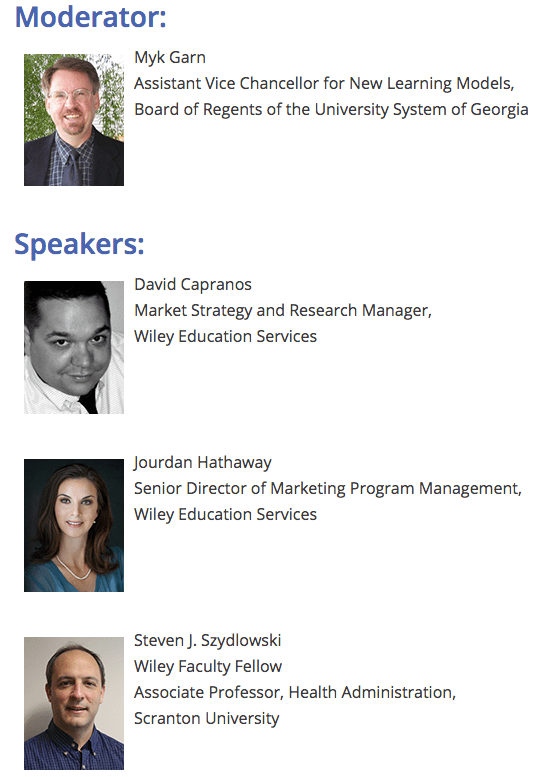
Panel Speakers
How SPD Works:
SPD involves analyzing trends in the market and understanding where the educational gaps and opportunities exist, not just to identify students, but also to help students prepare for jobs. By doing this, institutions can build efficient, flexible, and relevant online curriculums.
Quickly address changes in the market, without having to redesign an entire program.
Bridge outcomes with workforce expectations.
Identify employment needs/gaps to offer programs that will provide students with strong employment opportunities after graduation.
Make program planning and development more efficient.
Increase enrollments as students often prefer programs that allow them to focus on a specific, market relevant, specialization.
Strategic Portfolio Development – A Marketer’s Point of View
The approach of Strategic Portfolio Development influences marketing in two main ways:
First, is the University’s value story in the market place
Second, is the economic benefit to the marketing budget
Let’s start with unpacking how a University builds its value story. We have things like history, mission and credentials – these are long established macro-level brand ingredients. The value story is further made by factors that are rapidly evolving – program differentiation, outcomes, and the online environment itself.
The Intersection of Institutional Competency and Today’s Student Journey.
So where does Strategic Portfolio Development come in to this? In effect, it helps the school become a center of excellence in a set of scalable disciplines, which in turn, helps build competitive differentiation. While SPD has great internal benefits for the school, it’s also a student-centric approach. I like to say that it’s the intersection of institutional competency and today’s student journey. When an institution can market a depth of experience that gives students meaningful choices, the value story further grows in the marketplace.
At Wiley, our strategic marketing direction starts with a solid understanding of the product portfolio and the markets it can serve. We’re immersing ourselves in the university brand and looking to understand the in-depth details of the programs. A competitive analysis is paired with this information to provide perspective on the landscape. It gives us a feel for where to position the program, department, or university at large, that allows for market differentiation. As much as I’ve used the word market differentiation, it’s most meaningful if that is arrived at from the student’s perspective. Gone are the days of using course catalog descriptions to sufficiently describe the program. Gone are the days of the online modality being unique. Students want to know the outcomes and the ROI. If there’s a set of related choices that can better speak to the nuanced need of a chosen career path, it helps build confidence.
Impacts the Efficiency and Scale of Budget
Let’s move on to the way Strategic Portfolio Development impacts the efficiency and scale of budget.
At The Onset of Research, Not Every Student Knows Exactly Which Degree to Pursue
Sometimes there’s an assumption that every graduate student knows exactly which program they want to pursue. The reality is, many of the initial searches higher up in the funnel are very broad. Students start looking for program comparisons. This often leads to uncovering a specialization, or even a different program, that the student didn’t know existed. I’ll give you an example. I was recently looking at search index that compared the terms ‘accounting masters’, ‘accounting MBA’ and ‘business masters’. On average, there’s 76% more searches for the broad term ‘business masters’ than searches for an ‘accounting masters’. And, ‘accounting master’s has 147% more searches than typing in ‘accounting MBA’. {for all you data scientists, I know you can slice the data in infinite ways and there’s conversion impacts at every level – this stat is to help get a broad point across}.
Now let’s imagine that the school could compete with any of these phrases. That’s exactly what happens with SPD if there’s a program suite that can be co-marketed today. Even if it’s messy internally because the programs come out of different colleges, there is real strength in marketing relevant choices together. Instead of building many one-off marketing assets that support a single program, you can consolidate. The speed to market is quicker because you can add a tangential option to an existing set of assets and marketing campaigns rather than start from scratch. From a paid media perspective, digital marketing efforts can be initially targeted to a larger audience which can result in a lower cost-per-inquiry.
See a Real Example of SPD in Action
Check out the WCET Webinar to see how this plays out in Scranton’s real world portfolio example. In the marketing section, we talk about how to market at the individual program level while bringing down costs in aggregate by marketing the suite at large. Market demand then dictates how inquiries shake out by program.
At Wiley, we underpin this strategy with sophisticated media technology that allows performance targeting and conversion modeling – but that’s a webinar for a different day.
Wiley’s Pacesetter Awards program honors colleagues who have made significant contributions to Wiley’s success. They are issued semi-annually on a fiscal year basis at the individual and team level. I’m so excited to share that I’m one of two recipients at the individual level.
Winners are chosen for achieving one or more of the following criteria:
Significant impact on Wiley’s financial results and/or strategic goals
Identification of opportunities that result in acquisitions, partnerships, joint ventures or alliances
Significant cost savings/expense reduction
Resolution of critical problems and obstacles to achieving goals; responsiveness to unforeseen circumstances
Outstanding technological innovation that increases revenue and/or reduces cost
Outstanding creative effort
Extraordinary level of intra-company service through demonstration of professional capability, strong interpersonal relations, cooperation and helpfulness
Extraordinary level of external customer service and leveraging of sales through customer relationships
Significant improvements in products, processes and workflow, or quality orientation (should result in increased revenue or reduced costs)
Other achievements or results involving specific objectives, projects, activities or tasks which significantly advance progress towards department, business or company goals
So what are my thoughts on all this?
Reflections From an Overachiever
High performers need their tenacious drive and skill to be cultivated, nurtured and course-corrected to reach their maximum potential. Coming to Wiley Education Services has provided that in so many ways. I am surrounded by incredibly talented folks from whom I am learning so much from. It’s been a foundation for growth and a catalyst for mentorship upstream, down and peer-to-peer.
Since day 1, I have felt empowered and championed for across the entire organization – which has in turn cemented my commitment to our collective success. The standard for performance is high, but what I find so compelling is the intangible dedication to professional development. It goes beyond formal reviews; it unfolds every single day organically by the culture (for those who seek it). This seems like a good stopping point to plug this quote:
I am also acutely aware that there is no story to tell without the efforts of my entire team. Whether they’ve helped me develop our strategic direction, or activated upon it with passion and commitment, the results are indicative of our collective strength.
Are you in a leadership role?
If yes, then I encourage you to truly invest in the talent around you. I am the byproduct of so many people investing in my academics, career and character over the years – and there’s been a lot of course correction needed along the way. Those hallway conversations, random phone calls, late night skype sessions, impromptu brainstorms, 1:1 meetings and informal mentoring make a really big impact on folks.
Are you the spouse or partner of a woman in leadership?
I know it feels like I’m doling out some sort of Oscar speech. Believe me, I’m not taking myself too seriously here. It’s just that the recognition has given me some time to reflect on my path. This is where I have to give thanks to my #1 supporter – my husband Cam.
“When it comes time to settle down, find someone who wants an equal partner. Someone who thinks women should be smart, opinionated and ambitious. Someone who values fairness and expects or, even better, wants to do his share in the home. These men exist and, trust me, over time, nothing is sexier.”
― Sheryl Sandberg, Lean In: Women, Work, and the Will to Lead
The Hathaways invite you to enjoy this dreamlike sequence of a simpler time. Step inside the nostalgia of 1950’s family life. It is indeed those simple little ordinary things that imprint your heart with tender joy.
Remembering when…
…when an RSS feed meant Rise, Shine & Smile for breakfast
…when ‘face time’ happened around the table
…when a ‘like’ was a compliment paid in person
…when’ lol’ was truly laughing out loud
…when a ‘social share’ was when you split a coca cola
…when work and home rarely intersected
…when we pledged allegiance to more than 15 minutes of fame
…let us all remember that our simple moments will end up being our most treasured
“Remembering When” playfully relies on words that haven’t changed, but whose meaning has transformed in the wake of a new generation. The imagery draws upon the nostalgic (and very real) memories indelibly stitched in our childhood DNA. It’s the delectable Thanksgiving dinner smells permeating grandma Margaret’s house, the creative Halloween costumes hand made for Cam by Nana Penny, the green pancakes Christmas morning with papa Chuck, learning to ride a bike with Paw Paw Jerry, Nanny’s cookies that simply can’t be duplicated, arts and crafts projects with grandma Charlotte – and then there’s the Coca Cola legacy. Cam’s grandpa dedicated his entire life to working at the plant. Coca Cola wasn’t just a kitsch brand, it was a way a life. This is something our friend Ray has dedicated his collection to proving, so his home became the backdrop of our video.
It all started with a pink cherry apron
It started with a single point of inspiration: a pink cherry apron handmade by my neighbor for Madeline and me. From the moment I unwrapped the mommy / daughter cooking treasure, my mind was transfixed on old Betty Crocker ads. I had visions of the tender moments of a simpler time. Then there was the dress: Modcloth’s Comedy Hour Dress in Solid Red. I came across this stunning vintage dress and the concept unfolded.
Anyone who knows me has come to witness my love of written articulation of concepts that capture a slice of life; anyone who knows my husband has come to witness his relentless pursuit of visual elegance. So, when a writer marries a designer – this is what happens. Simple family photos take on a life of their own! (you should have seen our wedding 101 guide)
The concept
The concept is about re-framing our sometimes impersonal, technology-driven, family-fragmented, overworked lives and simplifying it down with a visual antithesis from days long gone. The irony is that Cam and I met online, both work in technology and my career aspirations are executive leadership.
I’ve been stuck in a paradox since the day I was born; I listen to Jazz, my favorite show is Bewitched and I adore device-free Sunday dinners. Come Monday morning, I want back in the conference room and thrive under tough business challenges. None of that takes away from the quest to slow down – even if it’s only for a photo shoot.
The talent behind it all
We’d like to sincerely thank the following folks for bringing this vision to life. Our industry is filled with extraordinary talent.






 After every QBR – I’d write my self-reflections of things I would have said differently. Then I’d figure out which of the senior executives on that call was an expert in the thing I botched. I’d immediately reach out and workshop how to approach it better next time. From our Chief Marketing Officer and Head of Legal to our Chief Strategy Officer and all our Business Performance Executives – I put myself out there. You’ll find that nearly everyone is willing to support your growth if you come with the right attitude and display authentic vulnerability (you better have their backs when they need your support as well).



 Obviously, innovation is really important; we all know that. I’m fortunate to work at a company that not only values it as a core principle, but has also built a really legit employee program around it.
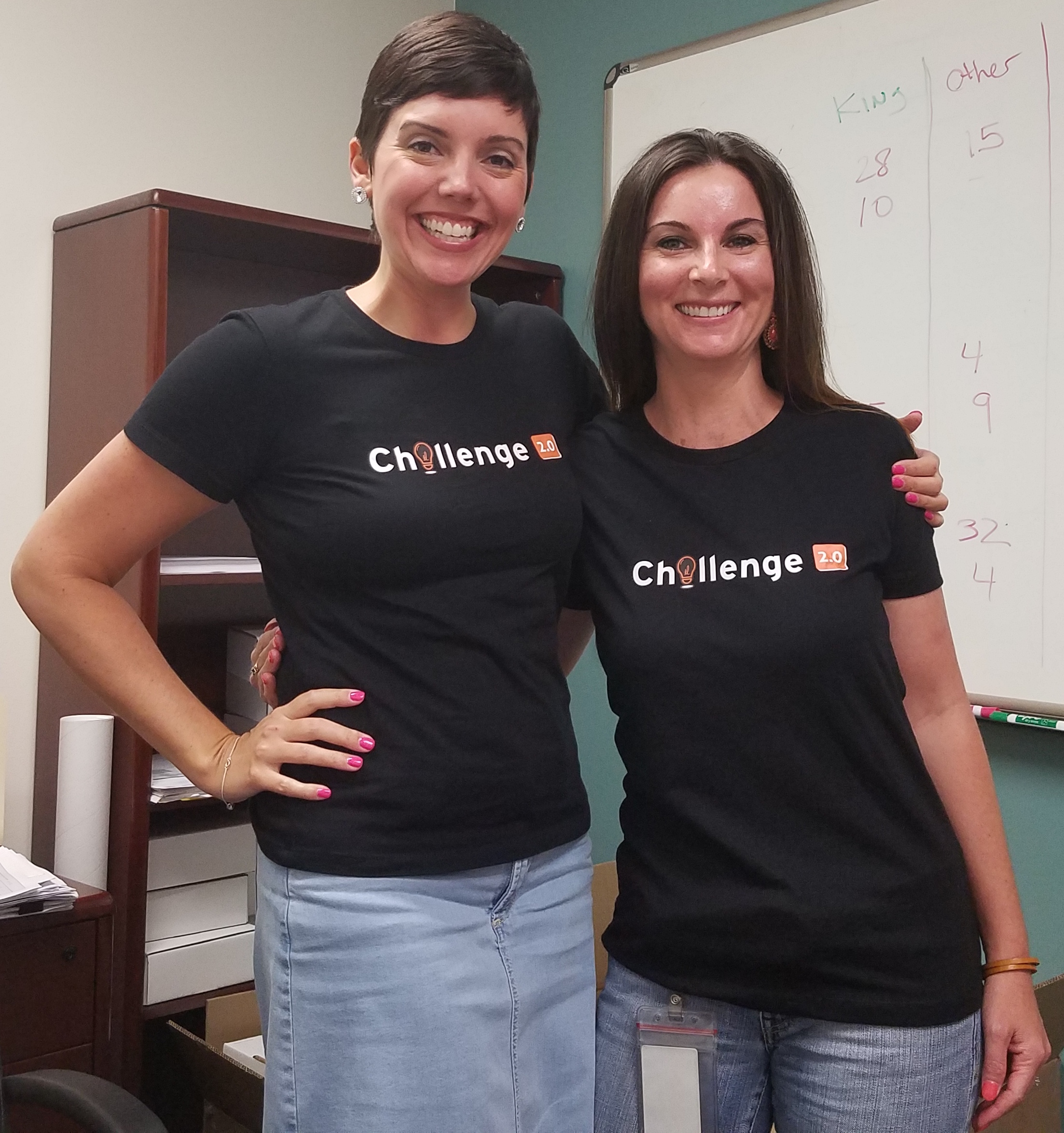 This year I was lucky enough to be on the judging panel. ‘Lucky’ because I got to detach from meetings, emails, and memos (awesome) to watch employees at every level, from across the globe, share their ideas to enhance or grow the business that we all work for (super awesome).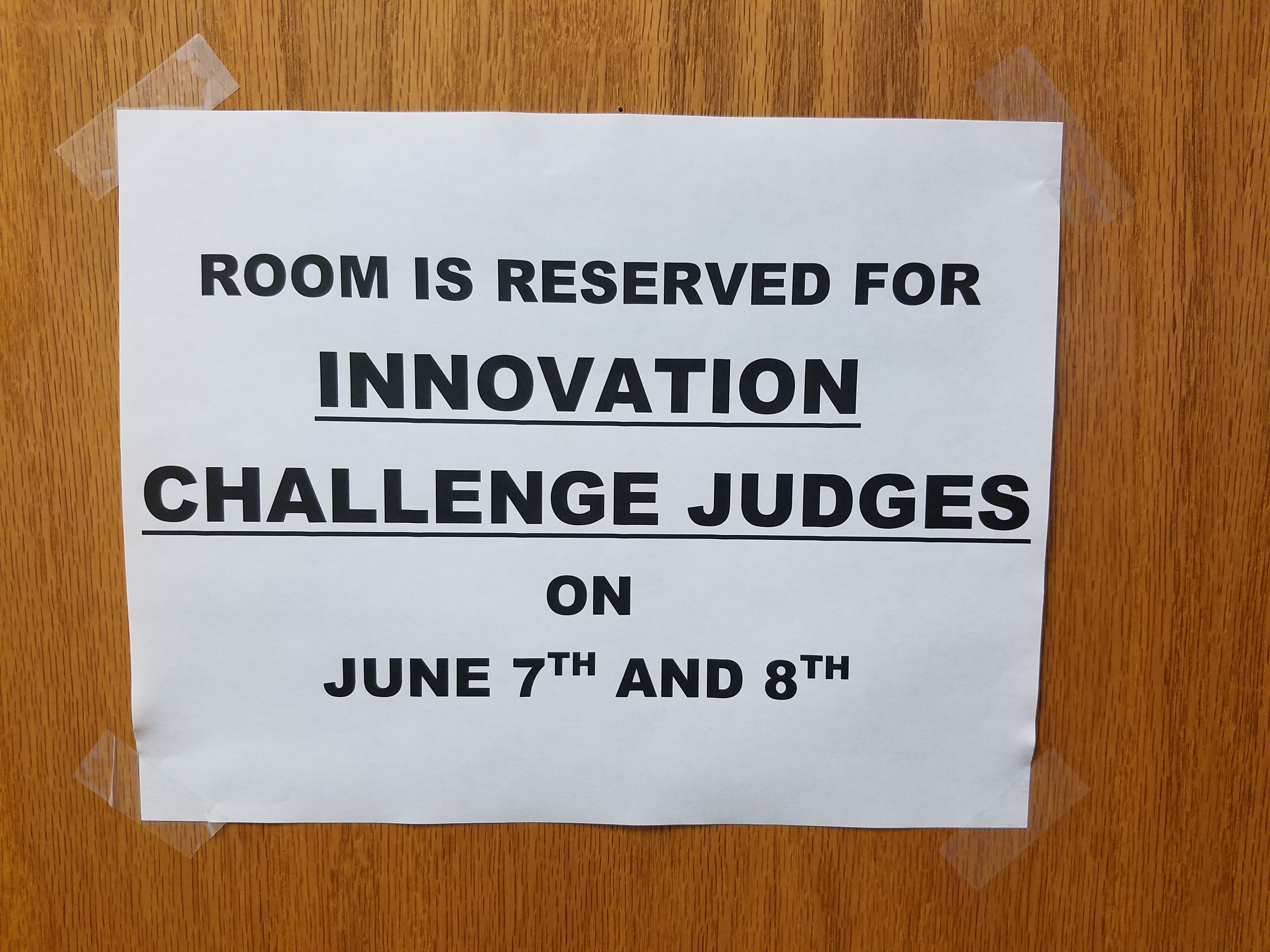

















 Jourdan Marie Hathaway